
Fire Prevention Week: The Fuel Load Above Your Line
Fire Prevention Week: what the grease above your cooking line actually is, how NFPA 96 sets the inspection interval, and what we find when we open the access panels. Cleaning Pros Plus.
Fire Prevention Week is a good time to say out loud what kitchen leaders already sense but rarely have in writing: the space above your cooking line is holding fuel. Grease vapor rises every time a burner lights, every time a fryer cycles, every time a griddle heats. It condenses on every surface it touches — the filter baffles, the plenum walls, the duct seams, the fan housing. The load is invisible from the kitchen floor, and it grows every single day the equipment runs.
That is not an argument for alarm. It is an argument for measurement.
What the fuel load actually is
Grease in an exhaust system is combustible material in a confined pathway that runs from the cooking line to the rooftop. When enough heat meets enough accumulated grease — from a flare-up, from an equipment malfunction, from a sustained temperature spike — the result is a duct fire. Duct fires are not slow. They move fast, they are difficult to suppress once established, and the duct itself acts as a chimney that carries the event toward the structure.
The five components that make up this pathway are the filters, the hood plenum, the horizontal duct sections, the vertical duct sections, and the exhaust fan and its housing. Each one accumulates grease at a different rate. Each one needs to be assessed — not assumed.
How the inspection interval is set
NFPA 96, the standard that governs vapor removal systems for commercial cooking operations, distinguishes clearly between inspection frequency and cleaning. Inspection frequency is set by the type and volume of cooking. A wood- or solid-fuel-burning operation carries a different inspection interval than a low-volume operation using only steam equipment. High-volume frying, charbroiling, and wok cooking sit at one end of that range. A kitchen that warms pre-cooked food sits at the other.
What the inspection measures is grease depth. Once an inspection reveals that accumulation has reached the level the standard identifies as the cleaning trigger, cleaning is required — regardless of when the last service was performed. Cooking type sets how often someone must look. What they find when they look is what drives the work order.
The edition of NFPA 96 that applies to your facility is the edition adopted by your local authority having jurisdiction. If you do not know which edition that is, your local fire marshal's office is the right starting point.
What we find when we open the access panels
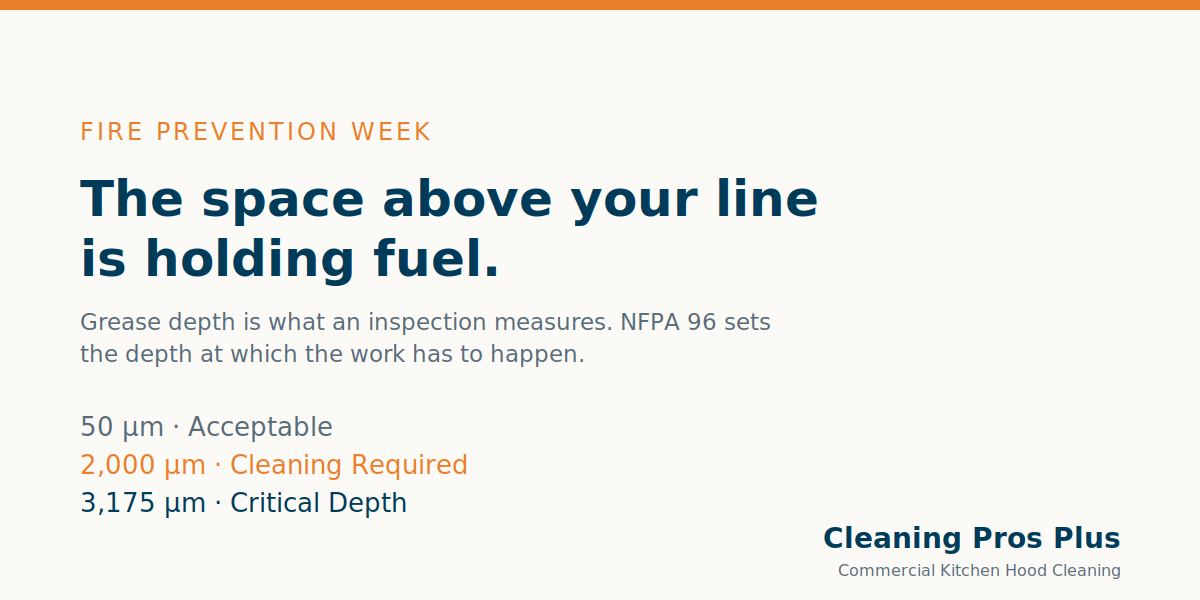
We work in commercial kitchens across the Central Valley, the Sacramento area, and the East Bay. When we pull an access panel on a duct that has been running past its inspection window, the picture is consistent: grease that started as a thin film has polymerized into a layer that is darker, harder, and thicker than most kitchen leaders expect. The standard identifies 50 microns as the Acceptable threshold — the mark of a properly cleaned system. It identifies 2,000 microns as the Cleaning Required threshold, at which cleaning is required immediately, and 3,175 microns in a fan housing as the Critical Depth, requiring cleaning without delay. Those numbers do not mean much until you see them on a gauge against a duct wall in a kitchen that has been running four services a day, six days a week, for six months without an inspection. At that point, they mean a great deal.
We measure. We record the measurement. We report what we found.
The five systems — what we check and why it matters
Filters and baffles. These are the first line of capture. Grease that saturates a filter and has nowhere to go begins tracking up into the plenum. We note their condition at the start of every service, because their state tells us what to expect deeper in the system.
The plenum. The space inside the hood body above the filters. Grease pools here in corners, on ledges, around the mounting hardware for the filters. We clean from this surface first, because this is what is directly above the open flame.
Horizontal duct sections. Horizontal runs are where grease settles and accumulates fastest. Every degree of slope that falls short of design spec is a place where grease pools. We access via the panels required under the standard, and we work in sections.
Vertical duct sections. These run toward the roof. They accumulate less by gravity but are not clean. They are also the sections that, in a duct fire, act as the flue.
The exhaust fan and housing. The fan is the endpoint of the pathway and it is one of the most neglected components we encounter. Fan blades that are coated in grease lose efficiency, draw differently, and — critically — carry combustible material right at the point where the system exhausts to the exterior. We clean the housing, the blades, and the grease collection reservoir. We note any mechanical concerns we observe, though mechanical assessment beyond the cleaning scope requires a qualified technician from the appropriate trade.
After a fire — what the record does
If a fire event does occur, the service record for the exhaust system becomes a document of consequence. Investigators will want to know when the system was last inspected, what was found, what was done, and how it was reported. A system-generated report with timestamped measurements and photographs is a different artifact than a handwritten carbon copy.
We use EvidLY for our post-service documentation. EvidLY generates a timestamped, photographic record of what was found and what was completed. Cleaning Pros Plus performs the work and reports what it measured. The record goes to the kitchen leader at the close of every service. We do not certify, seal, or validate the condition of the system going forward — we document what was true at the time of service.
The founder of Cleaning Pros Plus was retained as an NFPA 96 expert witness in a case involving a commercial kitchen fire. The detail that recurs in those situations is the absence of documentation — not a bad inspection, not a rushed cleaning, but no record that inspection or cleaning happened at all.
Who we are and what we hold
Cleaning Pros Plus is an IKECA member. Our founder holds CECS #200452 — the Certified Exhaust Cleaning Specialist credential — issued through IKECA. Our crew are PECT Designated Technicians. We state what we hold and we do not overstate what those credentials mean in any regulatory context.
The straightforward point for Fire Prevention Week
Your exhaust system is accumulating fuel right now. The rate depends on what you cook and how much. The only way to know where the accumulation stands is to open the system and measure it. If it is at or past the cleaning trigger, the work needs to happen before the next service day, not scheduled for next quarter.
We are in the Central Valley, the Sacramento area, and the East Bay. If your last service report is older than your inspection interval requires, or if you do not have a service report at all, that is where we start.